
Every brand activation begins with a very practical question, the answer to which will always come down to habit. What structure will go on the site? And the habitual answer is always the pop-up tent, because that’s what everyone uses, that’s what suppliers push, and that’s what the last event used.
Until the activation has a specific job that a standard frame can’t do.
Because sometimes the brief does not say “shelter some people”, but “be the one thing that stops foot traffic at a festival” or “be the thing people photograph” or “fit in a space a rectangular frame can’t”. Those briefs exist, and they come up more often than businesses anticipate, and the structure to solve them is rarely a pop-up.
It’s inflatable. Here’s how to know when it’s the right choice, and when it’s not.
Choosing the Right Setup for Maximum Impact and Visibility
-
When the Brief Demands Standing Out
Most events don’t need spectacle. Market stalls, trade show booths, and sponsor tables at a fun run all need clarity and professionalism, and a well-branded frame does this job perfectly.
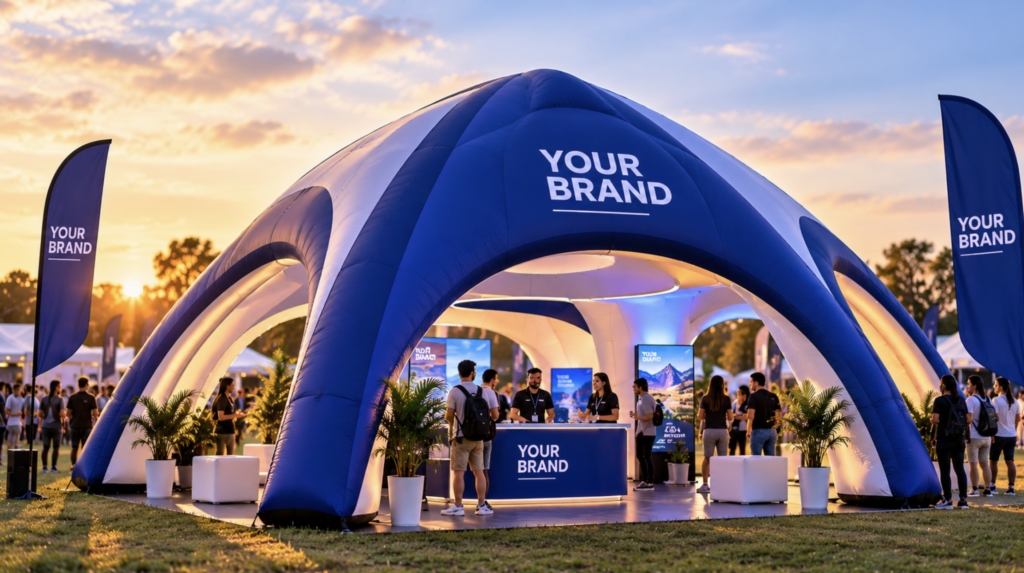
But some activities are explicitly about getting noticed, and that’s where the inflatable shines. A large sculpted shape, an arch, or even a large product replica with the logo wrapped around it will draw people in and stand out from the generic boxy white custom tents of the site.
In situations where the activation is in an area where the general environment is loud, that’s inflatable territory. This is a different job to do, and pretending a frame can do it is bringing a shelter to a spectacle fight.
-
The Practical Differences
Inflatables behave differently from frames, and the differences cut both ways.
Setting them up is genuinely fast. Sealed inflatable structures hold their air without a blower running all day, and airtight structures have come a long way to making the old complaint about constant noise and power reliance less of a thing. Weight is another win for inflatables, as most are significantly lighter than an equivalent metal frame, which is a consideration for people doing things solo or hauling them across fields.
The trade-offs are worth honesty, because an inflatable needs anchoring suitable for its shape, and a puncture (while rare in quality products) is a different kind of problem than a bent frame leg. Wind behaviors also differ, and where a frame tent will require staking and guy lines, inflatables require proper tethering at multiple points.
It’s nothing that can’t be read in a manufacturer’s anchoring spec, but it’s not something that can be winged.
-
Space and Shape Flexibility
Here’s an underappreciated benefit of inflatables.
They’re not locked into rectangles.
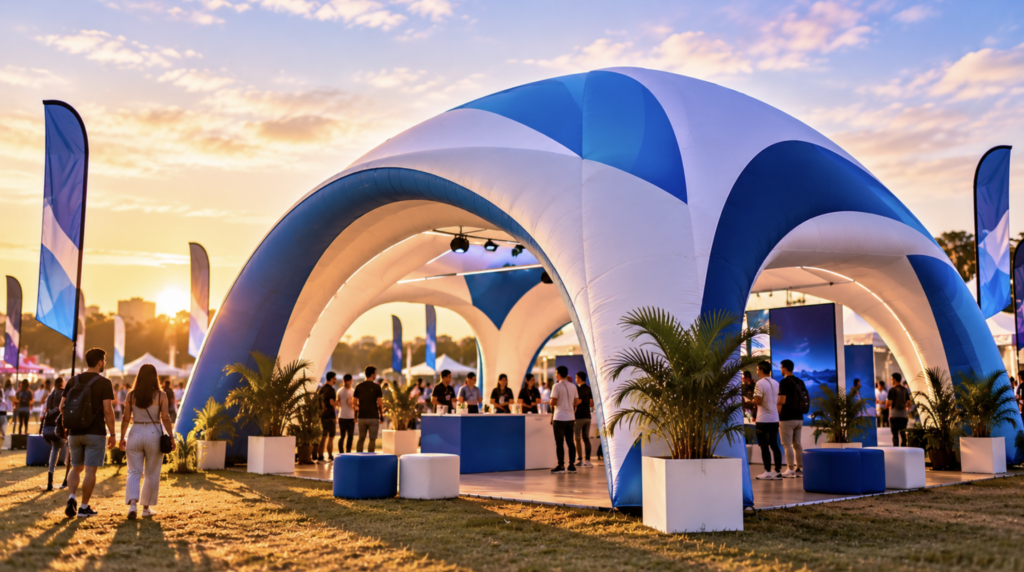
Odd shapes, curved layouts, and activation zones that flow instead of sitting in a grid are possible with inflatable structures in a way rigid frames simply can’t. Dome structures create a rounded enclosed feeling that works brilliantly for immersive brand experiences, and tunnels and arches connect areas together. Shapes that would need custom metalwork in a frame can all be air and fabric.
For activations that are more about the experience than the stall, that shape flexibility is often the deciding factor for an inflatable structure.
4. When a Smaller Structure is a Better Fit
Fairness requires the other side of this, and inflatables are the wrong answer for plenty of situations, and knowing that is just as important. A compact activation, such as a sampling table, a small retail pitch, or one with limited ground space, doesn’t need a huge sculpted structure, and the cost per event wouldn’t justify it.
Sometimes the right structure for a tight space is as simple as a custom market umbrella: branded and quick to position, with a small footprint and enough presence for a stall whose job is conversation over spectacle. Café-style activations, market stalls, or just outdoor seating areas can all be served well by umbrellas, and inflatables would be overkill with a price tag to match.
The decision rule is roughly this: spectacle and shape = inflatable. Standard presence and simplicity = frame or umbrella. Briefs that need neither extreme = frame.
5. The Question of Brand Visibility
Last consideration, and it’s a big one for activities specifically.
What do the structures look like from across the site and in photos? Frames are seen at eye level and read well up close. Inflatables are seen from all angles, are landmarks, and dominate photos in the best way.
If you’re measuring the activation’s success by social reach, that difference alone can decide the structure question. An inflatable at a festival will generate photos that a frame simply won’t, as it looks like a destination rather than a stall.
End Point
There’s nothing wrong with traditional structures; most events should use them, and most will. But brand activations with a spectacle brief, an odd-shaped site, or a social visibility goal are precisely the situations where an inflatable earns its place. Quick to set up in sealed designs, light to transport, endlessly shapeable, and impossible to mistake for the white canopy next door. The mistake isn’t choosing an inflatable. It’s choosing by habit when the brief was quietly asking for something else entirely.